BELABOX Alternative for IRL Streaming: Phone, SRTLA, or Hardware?
Compare practical BELABOX alternatives for IRL streaming, from a phone and VISP to SRTLA apps and managed broadcast hardware.
By VISP Team ·
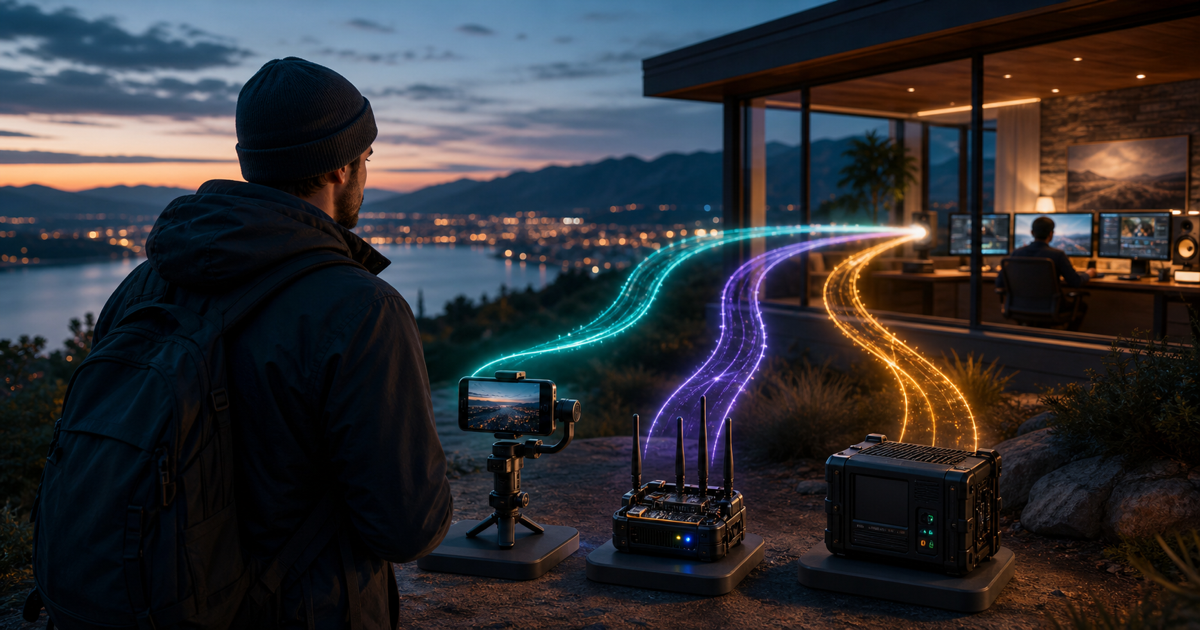
The best BELABOX alternative depends on what you are replacing. If you need a small field camera feeding an existing OBS studio, a phone and VISP may be the simplest answer. If several connections must contribute capacity to one uplink, use an SRTLA-capable app or another bonding system. If a supported appliance and managed service are the requirement, dedicated broadcast hardware remains the closer substitute.
BELABOX combines efficient field encoding, adaptive bitrate, SRTLA, compatible hardware and a cloud relay. No single alternative is automatically better at all of those jobs. Start with the failure your stream must survive, then choose the smallest workflow that actually addresses it.

Quick answer: choose by the job
| Requirement | Strong starting point | Why |
|---|---|---|
| Use a phone as a repeat field camera in home OBS | Phone + VISP | Few extra parts, persistent device path, OBS keeps scenes and stream keys |
| Combine Wi-Fi and cellular capacity | SRTLA app + compatible receiver | True multipath transport can use both links |
| Own and tune a dedicated encoder | BELABOX or another DIY encoder | Replaceable parts and detailed transport control |
| Buy an integrated supported appliance | LiveU Solo or similar hardware | Hardware, bonding service and support are packaged together |
| Bring a guest in through a browser | VDO.Ninja | Fast browser onboarding and interactive WebRTC fit better |
That table is a routing guide, not a feature score. A phone workflow can be the right professional choice when one connection is usually sufficient. A bonded box can be justified when route tests show that no single carrier can carry the chosen bitrate. The expensive mistake is buying a complex rig before measuring the problem.
What BELABOX is designed to solve
The official BELABOX belacoder project describes a GStreamer-based encoder with SRT output and dynamic bitrate, intended for systems that combine a single-board computer, HDMI capture and SRTLA. The separate SRTLA project spreads one SRT stream over several network links and reconstructs it at a compatible receiver. That is capacity aggregation and redundancy, not simply sending two complete copies of every packet.
This focus makes BELABOX attractive to creators who cross variable mobile networks and want control over cameras, modems, antennas, power and cooling. It also means the operator owns more hardware and more integration work. The official DIY tutorial covers supported builds and explicitly warns less-confident builders to wait rather than improvise with unverified parts.
Before looking for an alternative, write down which part matters: dedicated HDMI capture, SRTLA bonding, dynamic bitrate, a hosted receiver, or simply a reliable feed in OBS. Replacing only the job you need is usually cheaper and easier to rehearse.
Alternative 1: use a phone with VISP
For a creator who already owns a capable phone and runs OBS at home, VISP turns the phone into an authenticated video source. The phone publishes outward to a VISP relay, and OBS reads the separate receiving URL. OBS continues to own the Twitch or Kick destination, scenes, alerts, recording and final encoder.
This route removes the capture card, single-board computer, USB modem hub and custom enclosure from the field kit. It is a strong fit for city walks, event roaming cameras and occasional IRL broadcasts where one well-tested connection usually carries a conservative bitrate. Follow the video-source setup and the phone camera guide for the full path.
The boundary matters. VISP Native can duplicate packets over Wi-Fi and cellular for failover, but duplication does not add the capacity of those links. Both paths carry copies. If neither connection alone can sustain the stream, duplicate packets do not turn them into one larger pipe.
VISP's current third-party-encoder path also exposes an SRTLA receiver. That means an SRTLA-capable sender can aggregate compatible phone links into the relay. It does not turn the VISP native duplicate-link mode into bonding; these are two different senders and two different transport behaviors.
Alternative 2: use Moblin or IRL Pro with SRTLA
An app-based SRTLA setup keeps the phone as the camera and encoder while adding true multipath transport. Moblin documents SRTLA and simultaneous cellular, Wi-Fi and Ethernet use. IRL Pro is documented by IRLToolkit as an SRTLA mobile encoder. With a compatible receiving endpoint, either can spread a contribution stream across available links.
VISP shows an SRTLA publishing URL in the device's Advanced view. Its relay accepts SRTLA on UDP 5000, reassembles the contribution and makes the normal reading path available to OBS. The encoder and fallback documentation contains the current URL and receiver details. For Android, use the IRL Pro to OBS tutorial; for iPhone, start with the Moblin guide.
This is the closest lightweight alternative when the desired BELABOX feature is bonding rather than dedicated hardware. It still has phone constraints: heat, battery life, camera ergonomics, accessory routing and operating-system behavior. Test all intended interfaces during motion. Two network icons on a screen do not prove that two independent routes are contributing useful data.
Alternative 3: keep BELABOX, but simplify the build
Sometimes the strongest BELABOX alternative is not another product. It is a smaller BELABOX deployment. If dedicated HDMI capture and SRTLA are both hard requirements, removing BELABOX may recreate the same system with less coherent documentation.
Build the smallest supported configuration first: one capture input, one link and one receiver. Prove stable video into OBS, then add a second independent link, battery power, enclosure and the real route one variable at a time. The DIY BELABOX setup guide explains the Linux, modem, power and relay ownership that belongs in the decision.
BELABOX remains the better fit when the creator wants a dedicated configurable encoder, is comfortable maintaining it and values the ecosystem around that design. A phone alternative is simpler because it does less, not because it secretly replaces every part of the box.
Alternative 4: choose managed field hardware
LiveU Solo and similar products target creators who want an integrated encoder and managed bonding workflow rather than a DIY system. The official Solo PRO overview describes a portable hardware encoder used with LiveU's cloud service. That model can be worth it when the show has revenue, deadlines or clients that make vendor support and a consistent appliance more valuable than component-level control.
It is not the low-cost phone substitute. You are paying for a different operating model: dedicated capture hardware, a commercial service relationship and fewer self-integrated layers. Compare current hardware, service and data requirements directly with the vendor; avoid deciding from an old price quoted in a forum.
The VISP, BELABOX and LiveU Solo comparison goes deeper into those roles. The short version is that VISP starts from an existing phone and OBS studio, BELABOX starts from a configurable field encoder, and LiveU starts from a supported appliance and service.
What about VDO.Ninja or a direct phone app?
VDO.Ninja is an excellent alternative when the real job is onboarding a remote guest quickly. A guest opens a browser link, and OBS receives a WebRTC feed in a Browser Source. It is not a hardware bonding replacement. See the VDO.Ninja alternative guide if interaction and browser access matter more than a persistent field encoder.
A platform's own mobile app can also be the smallest solution for a simple one-camera broadcast. It removes home OBS and relay dependencies. The tradeoff is that the phone owns the destination session, and the creator gives up the home studio's scenes, recording, local fallback and operator controls. Direct streaming is not less legitimate; it is a different production.
Test the route before buying the alternative
Run a rehearsal where the stream will actually happen. Use the intended camera, bitrate, frame rate, power pack and mounting. Record which connection is active, then repeat at the same time of day while walking the route. A living-room speed test cannot reveal cellular handoffs, crowded venues or thermal throttling.
Use this escalation order:
- Lower the contribution bitrate until one connection has repeatable margin.
- Increase SRT latency enough to recover the route's packet loss and jitter.
- Keep OBS live with a local fallback while the field feed reconnects.
- Add a second independent network when one carrier is the measured failure.
- Move to dedicated hardware when phone heat, runtime or capture limits are the measured failure.
Each step buys a named improvement. Jumping directly to several modems and a custom enclosure makes diagnosis harder if the original problem was an oversized bitrate.
The practical recommendation
Choose a phone with VISP when you already have OBS, want stable named camera paths and can stream on one link. Add an SRTLA-capable app and receiver when testing proves that combined paths are necessary. Keep or build BELABOX when a dedicated configurable encoder is the point. Choose managed hardware when appliance support matters more than owning every component.
If the phone-to-home-studio path fits, try VISP with one source and one realistic route before buying more hardware. The test will show whether you need a smaller alternative—or whether BELABOX was solving the right problem all along.
Bring the field into your OBS studio
Try VISP free during beta. You never have to paste a stream key anywhere.
Try VISP free