IRL Stream Reliability: Why Buffering Costs You Viewers
Learn why buffering and ingest drops lose IRL viewers, and design BRB, reconnect, chat, bitrate, and bonding behavior that keeps the show coherent.
By VISP Team ·
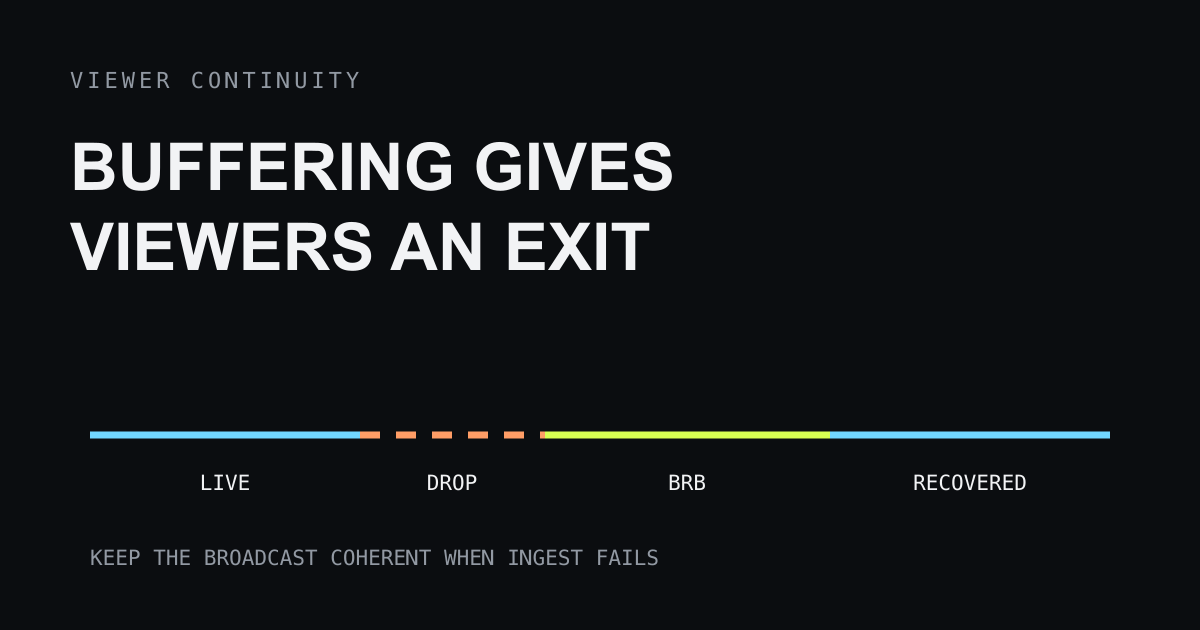
An IRL stream does not have to be visually perfect to hold attention. It does have to remain understandable. When video freezes, audio loops, the player buffers, and the broadcast suddenly ends, viewers cannot tell whether the problem will last two seconds or the rest of the day. Leaving is the rational response.
This is why reliability is not a background infrastructure metric. It is part of the show. A resilient IRL workflow tells viewers what is happening, keeps the platform broadcast alive when possible, and returns to live video without asking everyone to find a new stream.

Viewers experience uncertainty, not packet loss
The operator sees bitrate, round-trip time, retransmissions, encoder state, and relay logs. The viewer sees a much shorter list:
- moving video and intelligible audio;
- a frozen or buffering player;
- a clear temporary fallback;
- an ended broadcast.
Technical health matters because it changes between those states. But a dashboard showing successful reconnect attempts does not help a viewer staring at a frozen frame. Design reliability from the finished platform player backward.
There is no universal number for how quickly a viewer leaves. The decision depends on the audience, content, platform, and whether the interruption makes sense. The safe conclusion is narrower: unexplained buffering and repeated ended broadcasts create an easy exit, while a clear temporary state gives the audience a reason to wait.
Keep the broadcast separate from the field feed
The most important architectural distinction is between the contribution feed and the viewer-facing broadcast.
The contribution feed is the phone or field encoder sending camera video toward a relay, OBS, or cloud production. Mobile coverage can interrupt it. The viewer-facing broadcast is the finished program sent to Twitch, Kick, YouTube, or another platform. It can sometimes remain connected even when the field camera disappears.
If the phone publishes straight to the platform, both states may fail together. If a relay, home OBS, or cloud production owns the destination connection, it can replace a missing field feed with a local BRB state while reconnection happens.
That is the practical value behind the common promise to show a customized “be right back” screen when ingest drops and keep the stream running. The fallback does not restore missing video. It protects continuity and explains the gap.
Define the states before automating them
A reliable show needs explicit states, not one generic “offline” flag.
| State | What the system knows | What viewers should see |
|---|---|---|
| Live | Recent field audio and video are arriving | The live program |
| Suspect | Delivery is briefly late or degraded | Usually keep the last stable program momentarily |
| BRB | The field feed is unavailable beyond a short threshold | A clear fallback with no false promise |
| Recovering | The publisher reconnected but is not yet stable | Keep BRB until video and audio are usable |
| Ended | The creator intentionally stopped or recovery expired | End the platform broadcast cleanly |
The suspect and recovering states prevent rapid switching. Mobile networks are noisy. A single delayed packet should not flash a BRB card, and one returning video frame should not immediately switch the show back to live.
Use a short confirmation window appropriate to the latency and transport. The exact threshold needs route testing. The design principle is stable: enter BRB after a meaningful interruption, and return only after a sustained healthy feed.
A BRB screen is a continuity tool
A useful fallback answers three questions without making claims the system cannot guarantee:
- Is the broadcast still active?
- Is the interruption known?
- Should the viewer wait or return later?
Keep the message short. “Signal interrupted — reconnecting” is more honest than “back in 30 seconds” when the route may have entered a long dead zone. Match the visual style to the channel, but make the state readable on a phone screen. Avoid tiny support text, dense instructions, or motion that consumes unnecessary bandwidth.
Audio needs a deliberate policy too. A frozen fragment or looping half-word is worse than silence. A local music bed may create licensing or loudness problems. Use silence or an owned, tested fallback track, and confirm what the final platform player actually receives.
VISP Direct can keep the destination output in the relay and show a BRB card when the publisher drops. The card is optional and off by default: turn on Show a BRB card when my stream drops on the dashboard BRB tab. A home OBS workflow can do the same with a local fallback scene. The BRB screen without OBS guide compares those paths.
Tell chat before chat has to ask
A video fallback is visible only to someone watching the player. Chat may be in a separate view, and audio-only listeners may not see the screen. A concise bot message can confirm that the system detected the interruption and another can announce the return.
Do not spam every reconnect attempt. Send messages on meaningful state changes: live to BRB, BRB to recovered, or a clean end. Rate-limit repeated transitions on a flapping connection. A message should describe the viewer impact, not dump internal error codes.
The IRL chat bot alerts guide covers a relay-driven workflow for Twitch, Kick, and YouTube. The same principle applies to a moderator-operated show: communicate once, clearly, from the system that knows the actual state.
Reconnect without creating a second failure
Automatic reconnection is necessary but incomplete. The publisher, relay, production layer, and platform output each have their own connection state. A field app reconnecting successfully does not prove that decoded video is stable, audio timestamps are correct, or the final output returned.
A safe recovery sequence is:
- keep the platform output and BRB state running;
- accept the returning publisher connection;
- wait for decodable video and usable audio;
- confirm health for a short window;
- switch back to the live scene;
- announce recovery once.
Watch for stale frames after reconnect. The newest available frame matters more than draining an old queue. Long buffers can turn a recovered stream into video from the past. The correct transport and latency settings depend on the route, but every setup should verify that recovery returns to current action.
Prevent avoidable buffering first
Fallback is not permission to run an unstable bitrate. Start with a video rate one connection can sustain during movement, not the maximum shown by a stationary speed test. Leave headroom for radio changes, protocol overhead, and other phone traffic. Use adaptive bitrate where the encoder and workflow support it.
SRT can retransmit lost packets inside its latency window and handle jitter better than a transport with no recovery. It cannot send through a complete coverage hole. Increasing latency indefinitely also delays interaction and may only postpone the visible failure.
Test the real route at the expected time. Crowds, cell handoffs, buildings, weather, and movement change upload behavior. The mobile bitrate guide gives starting points; field testing decides the final value.
Know when continuity is not enough
A BRB screen preserves the show but not the event. If the audience must see a race finish, breaking news, a paid performance, or another unrepeatable moment, live field video may need to survive one connection failing.
That is when independent links and true bonding become operational requirements. The VISP phone app's optional Network bonding can combine Wi-Fi and cellular or send every packet over both; dedicated bonding encoders and services are the next step up. Several links can reduce dependence on one carrier, although shared coverage, congestion, hardware, power, and the relay remain possible failures. Bonding is another resilience layer, not a guarantee.
If a short interruption is acceptable, graceful fallback may produce a better cost and complexity tradeoff. State that requirement before buying hardware: “the platform stream must remain live” and “the field picture must remain live” are different goals.
Rehearse failure, not only success
A test that starts and stops normally proves almost nothing about recovery. Run a private or low-stakes broadcast and deliberately create controlled failures:
- disable Wi-Fi while cellular remains available;
- move through a known weak section of the route;
- interrupt the publisher long enough to trigger BRB;
- reconnect and confirm the return is current and synchronized;
- restart the field app while the platform output stays live;
- verify chat notifications and rate limiting;
- intentionally end the stream and confirm it does not remain stuck on BRB.
Have another person watch the actual platform player over an unrelated connection. The phone preview and relay dashboard do not include every output failure. Record the timestamps of state changes and compare them with logs after the test.
Measure viewer-facing reliability
Useful measurements describe the experience:
- number and total duration of buffering or BRB periods;
- time from ingest loss to a clear fallback;
- time from stable reconnect to restored live video;
- number of unnecessary fallback switches;
- broadcasts that ended and required a new platform session;
- chat messages emitted per real interruption;
- whether audio and video returned synchronized and current.
Pair those with transport metrics such as bitrate, packet loss, reconnect count, and path health. The experience measurement says what happened; the transport measurement helps explain why.
Avoid claiming “zero downtime” when the camera was unavailable behind a BRB screen. Say exactly what the design protects: the platform broadcast remains connected during eligible ingest interruptions, viewers receive a fallback, and the field feed is restored when it becomes healthy. Honest language produces better tests and fewer surprises.
Reliability is a product decision
Creators notice reliability features because they solve the moment when the show is most vulnerable. A customized fallback, continuous platform session, clear chat notice, and predictable recovery make the system feel operated rather than abandoned.
Build that behavior before adding decorative complexity. Use a conservative bitrate, a recoverable transport, automatic reconnect, explicit live/BRB/ recovering states, and one tested viewer-facing fallback. Add bonding when the field picture itself must survive a link failure. Add managed production when an operator or support requirement earns it.
Viewers do not need to understand the network. They need the show to make sense when the network fails. That is the reliability mandate: reduce preventable interruptions, explain unavoidable ones, and return without making the audience start over.
Bring the field into your OBS studio
Try VISP free during beta. You never have to paste a stream key anywhere.
Try VISP free